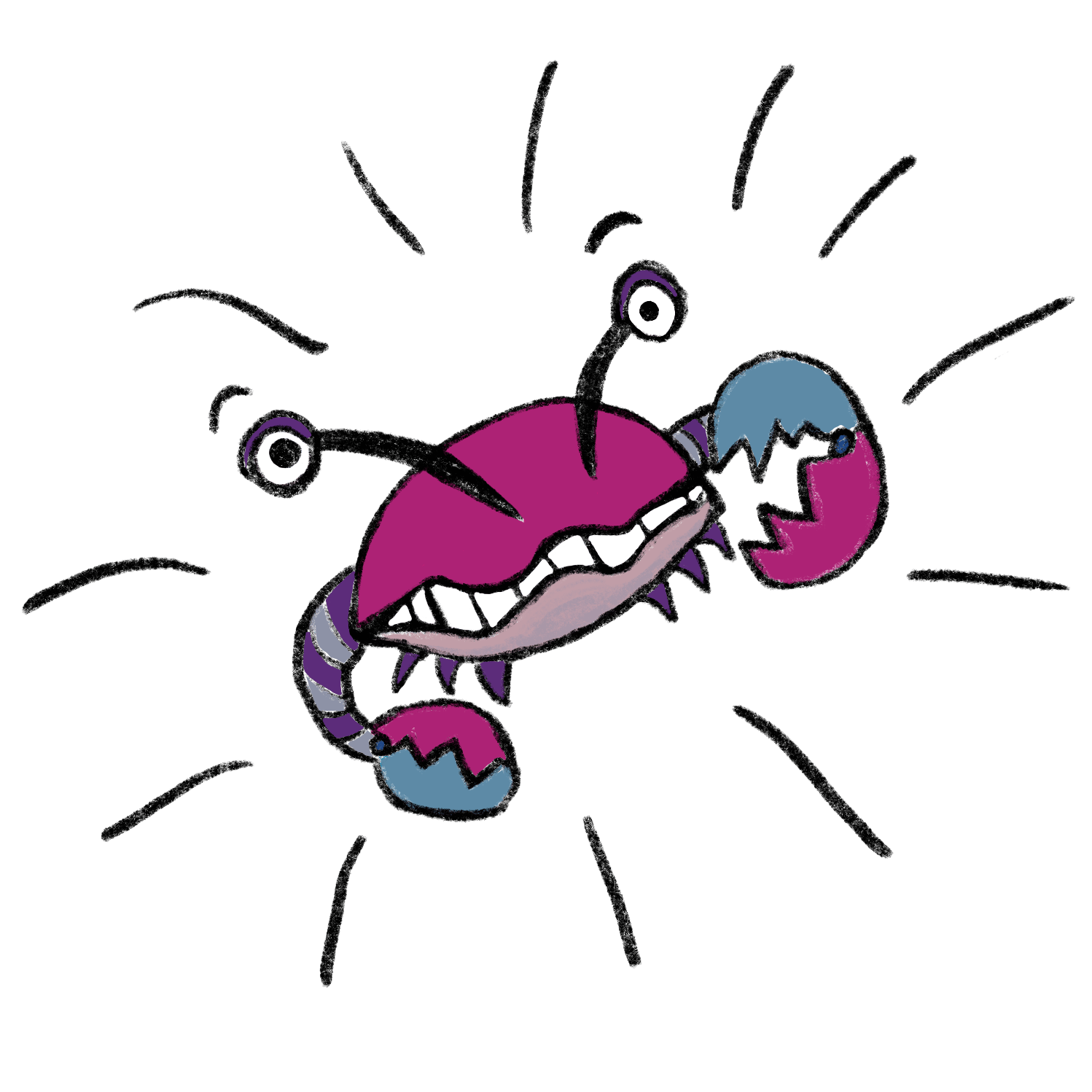

It is the myth of attainable stasis that propels us forward—we fling ourselves at one another, drunk on the belief that our egos could possibly live forever. The myth of being able to generate fixed points and stake our claims upon them causes us to tear each other apart like the wild animals we truly are.
You never step into the same person twice.
Our elders chide, “This is no laughing matter!” But this itself is laughable. We must laugh, we must remain flexible, we must make peace with the flux and roll of the absurd. With the flip and the flop and the flippity flop. Gettin’ froggy!
We are creatures of change paradoxically seeking to stake a claim. To create our own meaning. To carve out a niche and find ourselves. To imagine ourselves as free of the limits we’ve managed to cut out of whole cloth. To imagine ourselves as the sorts of beings that could boldly go somewhere we haven’t been before—somewhere our carbon, calcium, oxygen, and iron atoms haven’t already gone. Somewhere they aren’t already.
So here’s a thing. Wars are generated from a stopped up place, a (middle) finger shoved into the dike of flux, change, movement. Movement is nature is change is flux is movement. Life is a flood and the levy’s gonna break. The next thing you know, there goes the neighborhood.
And yet we obsessively attempt to fix so many points; we fix our very selves into points, and we burrow as deep as we can. We fixate on points. We have our squeaky little gray matter hammers, we aren’t afraid to use them, and the whole world’s a by god nail.
We look at ourselves and we see a single thing—a body bounded by flesh, bone, and blood. We don’t see that we’re mostly made of space. Our brains are elegant movement in liquid flesh, electrical impulses coursing through goo, perception emerging only to find itself physically bounded and finite and terrified, trying to duck back into its den like a forlorn groundhog on the cusp of spring. The universe handed a life sentence of solitary confinement in a bone prison.
The form of the thing that makes any of this pointless navel-gazing possible in turn supports the illusion of separation, thereby solidifying a sickening sensation of stationary stuck-ness. Form and function working hand in fist, and fist in jaw.
We are gobsmacked by the limitlessness of what surrounds our perceived bounds of self. We feel so small, so very very small, and we consistently fail to recognize the infinite as part of ourselves and vice versa. The parts are inseparable from the whole, the whole is the sum of its parts. But we want to see the parts. We want to see gaps where truly there are none. We are myopic. Our senses are solipsistic.
All we are, all we have become, and all we can hope to achieve with our big, fancy Selves is to be the best windmill warriors that we can possibly be.
Our brains are just big enough to begin to comprehend the true absurdity of ego and the myth of the existence of the individual—and the far more insidious myth of the importance of the individual. That blob of gray, electrically charged goo is just sizeable enough to get us into trouble, and lots of it. But still juvenile enough to appreciate a truly messed up joke.
Also—and most unfortunately—the goo is just big enough to have forgotten how to play without any rules. Too big for its britches, if you ask me.
And so, I ask you, what could possibly be of less consequence than one single, solitary, unyielding individual who has forgotten how to play? How can I even begin to speak of such a thing?
Hold my beer.
The misguided consciousness clinging to the value of its allegedly separate existence, centering its attention on itself while tethered by reality to both its infinite divisibility and its role as a random node among an infinite multitude? It is of great consequence to this brief pitter patter of biological life. After all, someone has to make the memes.
Our selfishness preserves us, and our selflessness ensures our immortality.
Where does a person even start? And how can a person ever end?
Maybe partying will help.
Addendum
Transcript
Creativity is not a talent. It is not a talent. It is a way of operating.
In fact, McKinnon described this particular facility as an ability to play—indeed, he described the most creative when in this mood as being childlike. For they were able to play with ideas, to explore them—not for any immediate practical purpose, but just for enjoyment. Play for its own sake. Because we’re not under pressure to get a specific thing done quickly—we can play, and that is what allows our natural creativity to surface.
Nothing will stop you being creative so effectively as the fear of making a mistake. Now, if you think about play, you’ll see why to play is to experiment. What happen happens if I do this? What would happen if we did that? What if the very essence of playfulness is an openness to anything that may happen— a feeling that whatever happens, it’s okay!
So, you cannot be playful if you’re frightened that moving in some direction will be wrong, or something you shouldn’t have done. I mean you’re either free to play or you’re not—so you’ve got to risk saying things that are silly and illogical and wrong, and the best way to get the confidence to do that is to know that while you’re being creative, nothing is wrong. There’s no such thing as a mistake, and any drivel may lead to the breakthrough.
—Excerpted from a talk by John Cleese on Creativity In Management
 Crabaghast!