
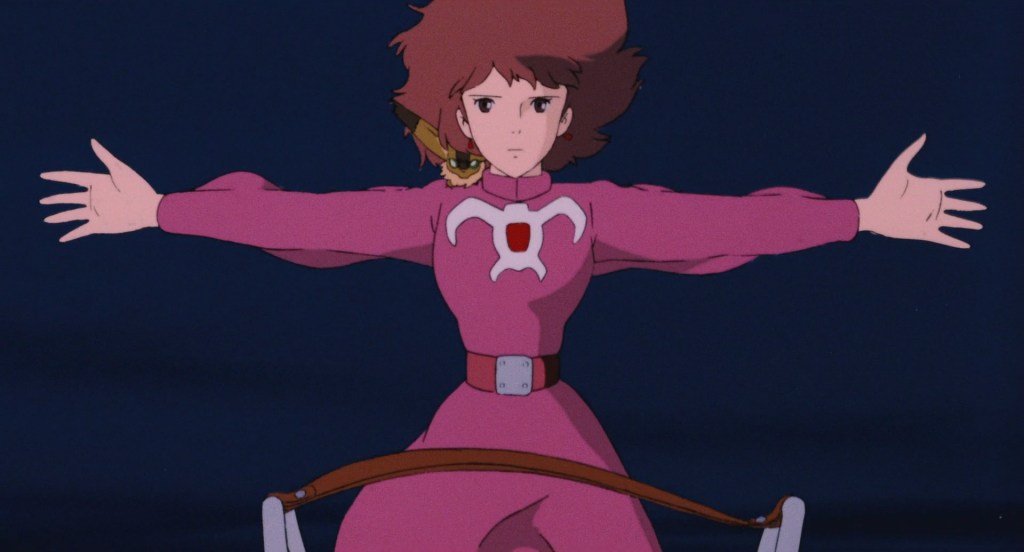
Oh how I love this little film.
While rewatching Nausicaä tonight, up to my gills in COVID, it occurred to me that Miyazaki is a propagandist. This film is straight up propaganda!
But it’s the best sort of propaganda, and I am a loyal party member. It’s propaganda for ecology, and for humanity. And also for reasoned emotion, emotional reason, authenticity, kindness, and purity of the soul. Purpose, duty, community.
Nausicaä is probably Miyazaki’s least complicated hero, and the story is a spacious and simple fable. Humanity has utterly destroyed the planet and yet continues to survive in predictable ways—flailing blindly against the unknown (nature) while justifying a perceived defensive stance with misguided reason. Yet these tired, unexamined ways of grabbing at life will only yield to future cycles of destruction.
“You have to look with better eyes than that.”
At her lowest point, consumed with grief and rage after having witnessed her beloved father’s assassination, and after having killed the assassins herself, Nausicaä proclaims to her teacher that she will destroy her secret greenhouse where she has worked so diligently to uncover the ways in which the planet is healing itself, independent of human influence.
She does not say that she “should” destroy it (at least not in the subtitled English translation), but that she will. She will burn it all. And once she says this, once she hears aloud her own nihilistic and impulsive intentions, she realizes the consequences of her future actions, and weeps.
Spoiler: she doesn’t burn the greenhouse down.
One of the best things about Miyazaki’s tales is that he chooses to reveal humanity from all its perspectives, like a moral Rashomon—and each of the three human perspectives in Nausicaä is understandable. No one faction is portrayed as evil incarnate, although there is a primary antagonist, and they do release an ultimate weapon in a desperate grasp at salvation. This is of course pure hubris, and that weapon proves to be an underdeveloped and impotent thing, falling apart even as it is deployed.
What unites humanity—even the military superpower bent on
control and destruction as the only way forward in a hostile world—is the clarity, command, and moral center of a confident young woman who sees that world with better eyes, and in so doing, arrives at the correct Understanding.
She communicates her Understanding by demonstrating it through determined and decisive actions—there are no lengthy monologues or pleading with politicians bent on conquest. She simply puts her body in the way of fearful bullets. Her emotions guide her reason, her reason provides context for her emotions, and her scientific inquiries are earnest and yield positive results. At Nausicaä’s core is an ethic of care—for the environment, for humanity, for creatures, for reason. And while in a moment of human vulnerability, she briefly abandoned that ethic, she is in fact utterly unable to act against her convictions.
Nausicaä’s Understanding is beautifully holistic. She sees humanity’s place within the overall ecosystem. She does not assume that the toxic earth and aggressive insects are inherently evil and at odds with human survival. Instead, she looks deeper and finds the truth of the interconnectedness of the living things within the ecosystem—plants, insects, and humans. She does not assume that the insects are without thought or feeling, but instead allows them their motivations. She does not resist. She communicates. She is compassionate. She bends the knee and yet does not yield.
She solves deep-seated, intractable conflicts by acting upon her knowledge and putting herself at risk to ensure that all are treated honorably. Humanity coalesces around her beautiful sacrifice, the creatures resurrect her, and a prophecy is fulfilled. Everything and everyone turns to its purpose at the end of the fable; humanity stops resisting its role and comes together to create a better way of living in cooperation and community. An ecology is sustained.
This is spiritual propaganda at its finest.
Also pretty sure the graphic designers for last couple Zelda releases were inspired by Nausicaä’s tale, too…

 Crabaghast!